
Whole-Life Financial Coaching: Coaching the Whole Life, Not Just the Money
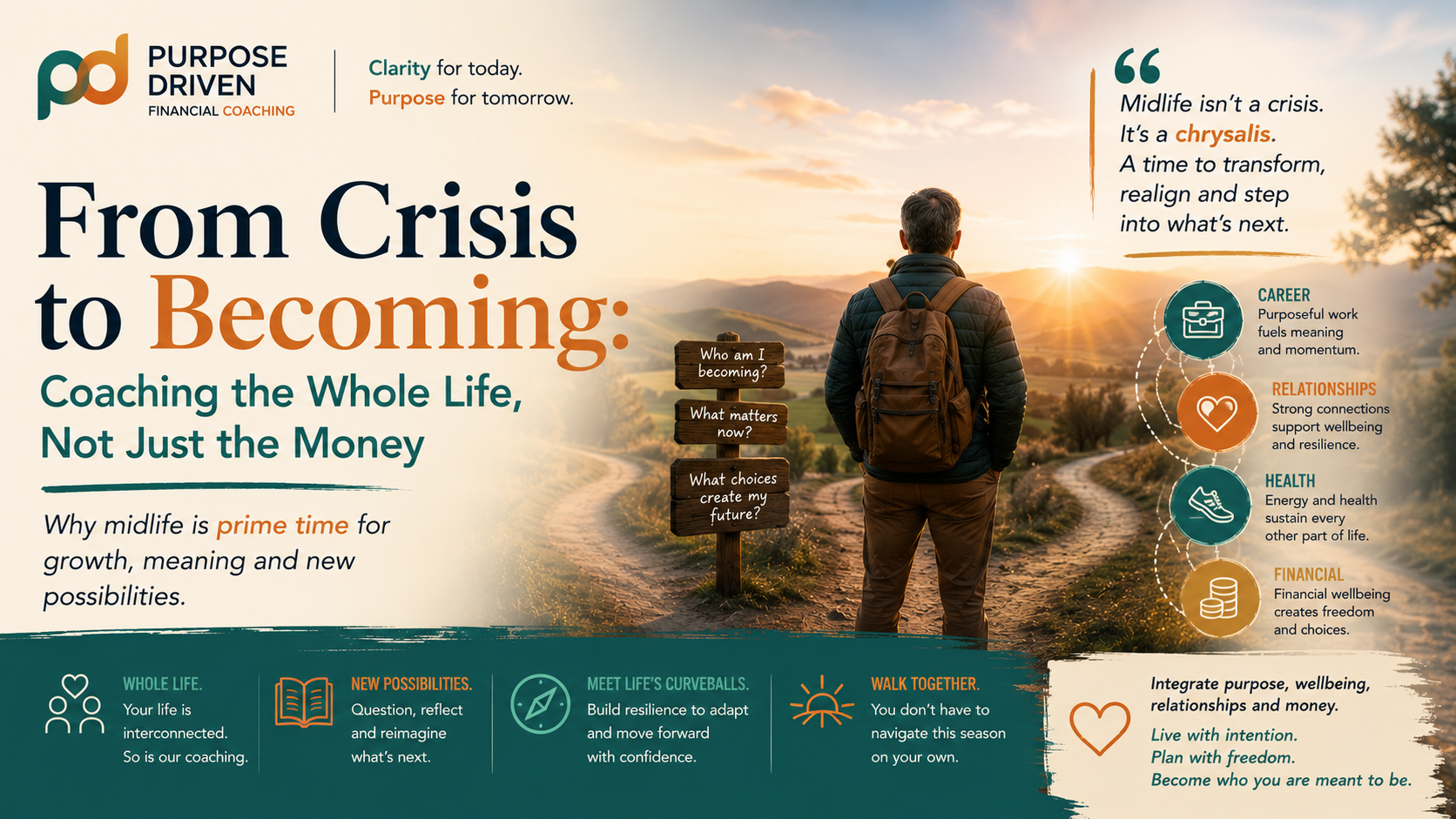
What is whole-life financial coaching?
Whole-life financial coaching treats money not as a separate box to be managed, but as one thread woven through a person’s health, work and relationships. Instead of coaching the money in isolation, it walks with the whole person, because a life and its finances rise and fall together.
I came to this way of working slowly, and then all at once. Money is one of the primary ways a human being tries to take care of what they care about. How a person earns, spends, saves, gives or avoids is never separate from the rest of their life. It is an expression of it. So when a client arrives with what looks like a money question, it is almost always a life question wearing a money disguise, and coaching only the numbers leaves most of the real work untouched.
What sparked this reflection on midlife and money?
The trigger was a podcast conversation between Chip Conley, founder of the Modern Elder Academy, and Dr. Margie Lachman, one of the world’s leading lifespan psychologists. Their exchange about midlife as a season of growth, not crisis, sent me straight back to a piece of research on how the domains of a life move together.
Lachman has spent three decades studying midlife. She was part of the research network that launched the landmark MIDUS study, Midlife in the United States, and remains one of its long-standing investigators, she directs the Lifespan Lab at Brandeis University, and she has just distilled a career’s worth of research into a new book, Primetime: A New Vision for Midlife. Her central argument lands like a quiet revolution: almost everything we think we know about the midlife crisis is a myth. Midlife is not the unhappy cliff-edge of the stereotype, and people in their middle years are not fixed and unable to change. Her research reframes midlife as prime time, one of the most fertile seasons for growth, agency and satisfaction, if we are willing to meet it as such.
Conley brought the poetry to her science. He described midlife not as a crisis but as a chrysalis, a dark, unglamorous, in-between place where the old shape dissolves before the new one has arrived. And he named the thing so many of my clients feel but rarely say out loud: that in our thirties and forties we climb onto a treadmill and run, until one day we look up and realise a treadmill never takes you anywhere, least of all somewhere you wanted to go.
Is the midlife crisis real, or a myth?
The popular midlife crisis is largely a myth. Decades of lifespan research, including the work of Margie Lachman, show that midlife is not reliably the unhappiest stage of life, and that people in their middle years are very much able to change. For many, midlife is a launching point, not a decline.
This matters enormously for coaching, because so many clients arrive believing the myth about themselves. They assume the best is behind them and that they are now fixed in place. When the science says the opposite, that change in midlife is not only possible but common, it hands us a genuine warrant for hope. The low point on the well-known U-curve of happiness, the dip many people feel around forty-five to fifty, is not the destination. For a great many people the years after the dip are richer, not poorer.
Why coach the whole life instead of just the money?
Because a life does not run in silos. Career satisfaction, physical health, relationship quality and financial well-being are dynamically linked, and a change in one spills into the others over time. Coaching only one domain works against the grain of how a life actually holds together.
Longitudinal research, including the work of Kinnunen and of Golombek and colleagues, describes two kinds of feedback loop. In a virtuous cycle, a gain in one area reinforces gains elsewhere: financial stability lowers stress, which protects health, which sustains work and relationships, which in turn shore up finances. In a vicious cycle, a shock does the reverse, cascading from money to health to relationships to work and back again. The difference between the two is often less about the size of the shock than about whether it depletes or replenishes the resources a person needs to respond. This is exactly why an integrated approach outperforms a domain-by-domain one.
How does financial stress affect physical health?
Financial and psychological stress does not stay in the mind. Through markers such as cortisol, inflammation and what researchers call allostatic load, prolonged money worry quite literally gets under the skin, and it shows up later as declining physical health.
The research on allostatic load, associated with McEwen, Juster and Lupien and with Kinnunen’s work on psychosocial stressors, treats these biological markers as the bridge between a lived experience of financial strain and a real, measurable toll on the body. When a client tells me they are exhausted, they may be describing their bank balance and their biology in the same breath. This is one more reason the money and the life cannot be separated: the strain in one is registered, physically, in the other.
What does the midlife crossroads actually feel like for clients?
It rarely feels like a dramatic breakdown. More often it is a low background hum: spinning too many plates, a career that has quietly become an obligation, a body that has started sending invoices, and money that was meant to bring safety but has become one more plate to keep spinning.
The mood I most often meet at this turn is not despair. It is closer to resignation, that flat conviction that this is simply how things are and will remain, or a low, humming anxiety about a future that feels unfaceable. In the South African context there is often the added weight of the sandwich generation and Black Tax, holding up aging parents with one hand and not-yet-launched children with the other, while supporting a wider family too. These are not character flaws. They are the emotional weather a client arrives in, and it quietly shapes what they can and cannot see as possible. Tend to how a person is feeling first, or the best financial plan in the world lands on soil that cannot hold it.
How does coaching help clients see new possibilities?
By helping them notice that a wall, looked at from a slightly different angle, is often a door. Clients arrive convinced it is too late to change, and lifespan research directly contradicts that belief. Coaching creates the conditions for a person to see the next chapter they had stopped imagining.
One of the myths Lachman dismantles is precisely the belief that people in their middle years are fixed and cannot change. Change in midlife is common. So the work is not to argue a person out of their wall, but to stand beside them until they can see past it. When a client begins to sense that the story is not over, something loosens. Their language changes, their body changes, they lean forward again. That leaning forward is the beginning of everything, because a person who can see a possibility can move toward it, and a person who sees only a wall cannot.
How can coaching help clients accept life’s curveballs?
By distinguishing acceptance from resignation, which are opposites. Resignation says nothing can be done, so why try. Acceptance says this is what is actually happening, and now, from here, what is possible? Acceptance is the clear-eyed starting point from which real choice becomes available.
Life does not stop throwing curveballs because someone has done the responsible thing. The research is blunt that shocks come to almost everyone, and that they cascade. When a client can stop fighting the fact of a retrenchment, a health scare, or a business that has run its course, and simply let it be true, an enormous amount of energy is freed up, energy that was going into the fighting and can now go into responding. Helping someone accept a curveball, gently and without rushing them, is often the single most useful thing I do.
How do you help clients question the standards they have inherited?
By treating the stories a client repeats as beliefs to examine rather than facts to obey. Statements like “my worth is my work” or “stepping back would be irresponsible” feel like reality, but they are usually inherited judgements. Coaching creates the space to pick them up, turn them over, and ask whether they are actually true.
So much of the suffering at midlife lives in these settled facts: that enough is always slightly more than a person has, that success must look the way it looked for their parents or their peers. Absorbed early and held long, they come to feel like the shape of reality itself. When a person realises that a standard they have organised their whole life around is one they never actually chose, they get to choose again. And choosing again is exactly the freedom this season of life is quietly offering.
Why is asking for support so important, and so hard?
Because support from others can interrupt a downward spiral before it accelerates, which makes it a structural protection, not a soft one. It is hard because many capable, successful people have built an identity on self-sufficiency, and asking for help can feel like admitting they do not have it handled.
The research of Mehreen and Ali on career shocks shows that support from others can soften a disruptive event so that it reverberates less. A relationship is not only an outcome of well-being, it is one of the ways well-being is protected. Part of the coaching relationship is simply modelling that asking is wisdom, not weakness. Sometimes that means a client finally talking honestly with a partner about money, sometimes letting an adult child carry a little of their own weight, sometimes bringing in the right professional at the right moment. Each is a thread of support that keeps a difficult season from spiralling, and each begins with the courage to say: I could use some help.
What practical tools support whole-life financial coaching?
The most useful tools make the connections between a client’s domains visible and turn vague unease into a specific conversation. A few earn their keep at this stage of life: a whole-life check-in, a support inventory, protecting the body’s basics, and a deliberate edit of commitments.
A whole-life check-in is an honest periodic look across career, health, relationships and finances together, so the hidden connections surface. A support inventory names the relationships and resources that could steady a difficult season. Protecting sleep, movement and rest as seriously as we protect an emergency fund treats the body as the real infrastructure it is, because a depleted nervous system cannot make wise long-term decisions and a rested one can. And what Conley calls the Great Midlife Edit translates beautifully into money: a deliberate review of commitments, subscriptions, obligations and even ambitions, asking of each what to carry forward and what to set down. In the South African context this is also where the concrete architecture matters, the risk cover, the estate planning, and the considered decisions around the Two-Pot retirement system, not as products to be sold but as scaffolding that lets a person face a transition without bracing against it.
Alongside the tools, I love the questions that gently unhook a person from the treadmill. If you had all the money you needed, what would you actually do with your one life? If you learned you had only a handful of years left, what would you regret not having done, not having been, not having had? These are the most financial questions there are, because the answers reorganise everything the money is meant to serve. The coach’s role is not to supply the answer, but to create the conditions in which a person discovers their own.
What does whole-life coaching look like in practice?
It looks like starting with the person, not the spreadsheet. A cash-flow question is often the surface of a much deeper life question, and answering only the surface leaves the client unchanged. The real shift happens when the person receiving the numbers is no longer the same person who walked in.
I think of a client, with details blurred to protect them, who came to ask whether they could afford to step back from a business they had built over two decades. We could have answered it in an afternoon with a spreadsheet. But the feeling in the room was resignation, and their story was full of settled facts: that stepping back would be irresponsible, that their worth was the work, that it was too late to want anything different. They were caring for an aging parent and quietly funding an adult child, and they were tired in a way that a holiday would not touch. So we started with the tiredness and what it was really reporting. We picked up a few of those settled facts and turned them over until they loosened. Somewhere in there they let themselves accept that the business had run its course, and the moment they stopped fighting that, a possibility they had not been able to see arrived on its own. The numbers came later, and they finally landed on ground that could hold them.
What does this mean for financial coaches and planners themselves?
The research on midlife is a mirror, not a window. Coaches and planners are inside the same U-curve, with our own spinning plates, our own tiredness, and our own unexamined standards. Experience does not exempt us from the patterns we are trained to notice in others.
If anything, success can make us more susceptible, because the more we have built, the more we have to defend, and the harder it becomes to see a possibility, accept a curveball, or ask for help ourselves. If I am not doing my own work, my clients will feel it, in ways neither of us can quite name, long before either of us could put it into words. The invitation of this research, for me, is to keep meeting my own crossroads honestly, so that I bring a settled and open presence into the room rather than a resigned or anxious one.
What is the real “art of financial prosperity”?
It is company through transition. The most valuable thing an integrated coach offers is not a plan or a product, but the willingness to sit with someone in the in-between place and hold, on their behalf, the belief that a new shape is forming even when they cannot yet see it.
A life is interwoven. Its parts cascade into one another for better and for worse, and money runs through all of them as an expression of how a person cares for what they love. To walk with the whole person, patiently, helping them see possibility, accept the curveballs, stay open to opportunity, question the standards they never chose, and reach for the support they need, is the real art of financial prosperity. Not the accumulation of a number, but the slow, integrated becoming of a person who arrives, on the far side of the chrysalis, more themselves than when they began. Lachman reminds us that midlife is not a crisis to be survived but a prime time to be lived, and our privilege as coaches is to walk part of that road alongside another human being, and to trust the shape that is quietly forming.
Frequently asked questions
Is whole-life financial coaching the same as financial planning? No. Financial planning focuses on the technical architecture of money, such as investments, risk cover and estate planning. Whole-life financial coaching addresses how money is woven through a person’s health, work and relationships, and how their beliefs and moods shape their financial behaviour. The two work best together.
Does midlife really get happier after fifty? Often, yes. The U-curve of happiness suggests life satisfaction tends to dip around forty-five to fifty and then rise again for many people. Lifespan research also shows people can grow and change well into their middle and later years, so the later chapters are frequently more satisfying, not less.
Can financial stress actually make you physically ill? Yes. Prolonged financial and psychological stress registers in the body through markers such as cortisol, inflammation and allostatic load, and is linked over time to poorer physical health. This is why money worries and health cannot be treated as separate problems.
How do I stop feeling stuck in midlife? Start by separating the facts of your situation from the inherited beliefs you have layered on top of them. Notice which “truths” are actually choices you never consciously made. Accepting your real starting point, staying open to unexpected opportunities, and asking for support are the first practical moves out of feeling stuck.
What is the Great Midlife Edit? A term popularised by Chip Conley for a deliberate review of your commitments, obligations and even ambitions, deciding what to carry into the next chapter and what to set down. Applied to money, it becomes a values-led review of where your resources, time and attention actually go.
References
Brim, O. G., Ryff, C. D., & Kessler, R. C. (Eds.). (2004). How healthy are we? A national study of well-being at midlife (The MIDUS study). University of Chicago Press.
Conley, C. (2024). Learning to love midlife: 12 reasons why life gets better with age. Little, Brown Spark.
Golombek, D., Eyre, H. A., Spiousas, I., Casiraghi, L., Hartikainen, K. M., Partonen, T., Pyykkö, M., Reynolds, C. F., Hynes, W., Bassetti, C. L., Berk, M., Hu, K., & Ibañez, A. (2024). Sleep capital: Linking brain health to wellbeing and economic productivity across the lifespan. The American Journal of Geriatric Psychiatry.
Juster, R.-P., McEwen, B. S., & Lupien, S. J. (2010). Allostatic load biomarkers of chronic stress and impact on health and cognition. Neuroscience and Biobehavioral Reviews, 35(1), 2–16.
Kinnunen, M.-L. (2005). Allostatic load in relation to psychosocial stressors and health. Jyväskylä Studies in Education, Psychology and Social Research.
Lachman, M. E. (2026). Primetime: A new vision for midlife. Simon & Schuster.
Mehreen, A., & Ali, Z. (2022). Really shocks can’t be ignored: The effects of career shocks on career development and how family support moderates this relationship. International Journal for Educational and Vocational Guidance, 24(3), 701–726.


