
Some weeks the research lands quietly. This was not one of them. Across June, July and August, a run of new papers and industry reports arrived that, read together, describe a profession standing at a threshold. Artificial intelligence can now assemble a competent financial plan in seconds, the COFI Bill is moving through Parliament, and clients are arriving with more complexity than they have in years. So I thought I would answer the questions I keep being asked, by planners and clients alike, as honestly as I can.
Will AI replace financial advisers?
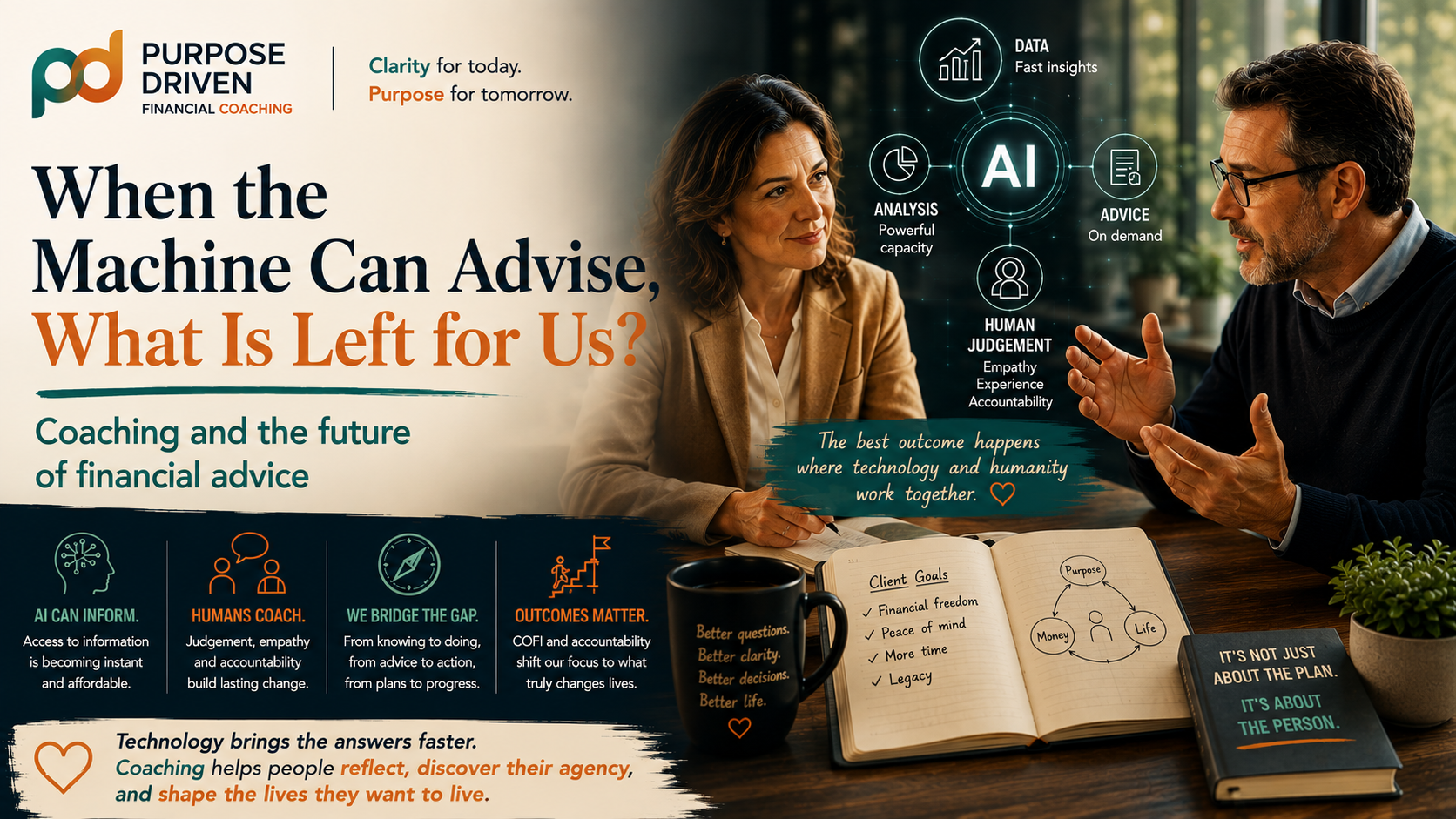
I do not think it will replace us, but it will quietly change what we are paid for. The research points towards a hybrid future rather than a hostile takeover. Deloitte, and the World Economic Forum working with Accenture, both describe a world in which automation widens a planner’s capacity while human judgement, governance and accountability become more important, not less. As information and plan-building become cheap and abundant, our value moves towards the parts of the work a machine cannot reliably carry: the judgement, the behaviour, the moment of decision. So the honest answer is that the threat is smaller than the fear, but the change is real.
Can AI actually give good financial advice?
More than many of us would like to admit, at least at the level of broad principles. When Taha Choukhmane and colleagues at MIT and Stanford asked a demographically balanced sample of American adults to write their own prompts asking for financial advice, and then simulated what would happen if people followed it over a lifetime, the recommendations generally nudged people towards sound life-cycle thinking. More participation in diversified equity funds, equity exposure that eases down with age, healthier savings buffers. That is not nothing.
But the picture is uneven, and this is where it gets interesting. The advice people received shifted with their financial literacy, their prior experience with AI, and even their gender. More structured prompts improved some things, yet the machine still stumbled on matters like active rebalancing and adapting advice as a client’s circumstances change. In other words, the quality of the answer depended a great deal on the quality of the question.
So if AI can build the plan, what am I paying a human for?
This is really the question underneath all the others, and it is worth sitting with rather than rushing past. If a model can put together a diversified, age-appropriate, well-buffered plan in seconds and at little or no direct cost, what exactly are our clients paying us for?
The answer, I think, is that you are paying for judgement, relationship and follow-through, not for information. Information is becoming cheap far faster than judgement is. The plan has never been the hard part. Doing the plan, and believing you can, when markets wobble and life interrupts, that is where a human still makes the difference. A machine can model the plan beautifully. It cannot sit with you while you decide.
What is the real difference between financial advice and financial coaching?
Advice tells you what to do. Coaching helps you become someone who can actually do it. An ontological lens helps me separate three questions that often hide inside a single conversation: does the client know, can the client do, and does the client believe they can. AI is strongest at the first and is becoming more useful across all three. What it cannot reliably do on its own is turn information into lasting capability, or carry responsibility for a client’s agency. That work happens through reflection, practice, relationship and action, which is precisely the ground coaching was made for.
Does financial coaching actually work?
I want to be honest here, because I think our profession sometimes claims more than the evidence yet supports. A May 2026 Campbell systematic review from Birkenmaier and colleagues looked at eleven controlled studies of financial coaching. Some reported small or moderate benefits, but ten carried important methodological weaknesses, and the interventions and outcomes varied so widely that the reviewers could not calculate a reliable overall effect. Their conclusion was not that coaching does not work. It was that we do not yet have robust enough evidence to say with confidence that it does. That should not discourage us. It should make us hold our claims lightly and measure our own work far more carefully than we tend to.
Why do people still trust a human over the machine?
Because trust seems to attach to something more than the facts. HSBC’s survey of around ten thousand affluent and high-net-worth investors across ten markets found that seventy-three percent already use AI for finance and investing. And yet only twelve percent said AI was the most influential factor in their last decision, while sixty-two percent still pointed to a financial professional as the source of their last investment idea. People are using the machine to explore, and turning to a human at the point of judgement and action. That distinction, I suspect, is the whole future in miniature.
Does the way advice is communicated really matter that much?
It appears to matter more than we might expect. In a preregistered experiment posted on 10 August, Kapadia and colleagues held the substance completely still, the facts, the numbers, the recommendation, and changed only the way the advice was communicated. Advice written in a Certified Financial Planner’s style was rated more favourably than advice in an AI-assistant style on nine of ten measures, and it still won on eight of ten even when people no longer knew the supposed source. It is worth being precise: this measured how people evaluated the communication, not whether the advice led to better outcomes. Still, it suggests there is something in how a skilled professional speaks that people quietly recognise and value.
How does the COFI Bill fit into all of this?
Rather neatly, as it happens. The COFI Bill keeps moving, with Cabinet having approved its submission to Parliament in April and the FSCA continuing to prepare for implementation. It carries forward a shift we have felt building for years, away from a narrow compliance-and-suitability mindset and towards genuine accountability for fair customer outcomes. That is the same direction the technology is pushing us. As advice becomes abundant, both the regulator and the market are asking the same question: not did you sell something suitable, but what outcome did the client actually experience? Coaching lives comfortably in that question.
What is AI literacy, and how do I help clients use these tools well?
AI literacy is simply the skill of getting good and safe use out of these tools, and I think it is becoming part of our job to teach it. In practice it means helping clients frame a clearer question, give the machine enough context, test the assumptions sitting underneath an answer, protect information that ought to stay private, and recognise the moment a response needs a professional’s eye. The research points to a working hypothesis I find useful: financial literacy and AI literacy shape how a person frames the question, the framing shapes how useful the answer is, and judgement, confidence and follow-through shape the outcome that finally lands.
What should I actually be asking my clients now?
Start with confidence and action, not just knowledge. There is a simple sequence I keep coming back to: what do you understand, how confident are you, what normally gets in the way, and what will you actually do next? To that I would add one scaling question that earns its keep: on a scale from one to ten, how confident are you that you can make this decision and follow through on it, and what would move you a single point higher? And at the annual review, one more question opens the balance sheet clients truly live on: apart from what has changed in the numbers, what feels different about your financial life compared with a year ago? That last one quietly measures control, peace of mind, freedom of choice and hope for the future.
So where does this leave the financial planner?
Standing exactly where we are most needed. As advice becomes abundant, our value moves steadily towards the moments of judgement and action, which is where COFI is pointing the whole industry and where the hardest cross-border, transitional and genuinely complex work already lives. The future planner’s advantage will not be holding information a client could never find for themselves. It will be creating a relationship in which someone feels understood enough to examine an assumption, face a difficult behaviour, move through a transition, and act.
Money, after all, is never only money. It is an expression of how we care for what we love. A machine can model the plan. It cannot love on our behalf. And that work, quietly, remains ours.
A note on how this was made: the underlying research was gathered through my weekly briefings and weekend Paperguide reading. AI tools supported the initial drafting, source verification and proofreading. The thinking, framing and final editorial choices remain my own.
References
Bank of England. (2026, July). Financial Stability Report: July 2026.
Choukhmane, T., de Silva, T., Lin, W., & Akuzawa, M. (2026). AI financial advice: Supply, demand, and life-cycle implications [Preprint]. arXiv.
HSBC Holdings plc. (2026, June 24). The Trust Threshold: AI makes investors bolder, but they want human judgement to make decisions.
Kapadia, A. R., Chandrasekharan, E., & Saha, K. (2026). How people evaluate AI-, expert-, and peer-style financial advice [Preprint]. arXiv.
Levi, J. A., & Hazuria, S. (2026, May 20). The agentic AI productivity wave is heading for wealth management. Deloitte Insights.
World Economic Forum. (2026, June 24). The AI playbook for financial services. Developed in collaboration with Accenture.


