
A few weeks ago I was listening to Ronel Jooste’s podcast, and her conversation with Tal Ben-Shahar on the SPIRE model stopped me mid-walk. It triggered a memory of an article I’d read some years ago by Sarah Asebedo and Martin Seay, Functioning to Flourishing: Applying Positive Psychology to Financial Planning, and suddenly the two ideas were talking to each other in a way I hadn’t expected. That conversation is what sparked this piece.
What Is the Difference Between Financial Functioning and Financial Flourishing?
This is the question that sits at the heart of a lot of what I’ve been thinking about lately.
Financial functioning asks: Is my financial life working?
Financial flourishing asks: Is my financial life helping me become who I want to be?
It sounds like a subtle distinction. But in practice, it changes everything about how we show up as financial coaches and planners.
A functioning-focused planner builds a plan. A flourishing-focused coach builds a conversation. The plan itself may look identical. What changes is the meaning the client takes from it, and the identity they inhabit inside it.
Asebedo and Seay make this point powerfully in their research. Two clients with identical balance sheets can experience completely different levels of life satisfaction, confidence, stress, and hope. Financial wellbeing cannot be understood purely through objective indicators. It also includes subjective experience.
Why Is Traditional Financial Planning Not Enough on Its Own?
Traditional financial planning has delivered enormous value. It helps clients answer foundational questions:
- Can I retire?
- Am I adequately insured?
- How should I invest?
- How do I manage debt?
- What should my estate structure look like?
These questions remain non-negotiable. Technical competence still has to be excellent.
But here is what I’ve noticed in my own practice: clients don’t come to us because they want a financial plan. They come because they want a different feeling about their future.
They want to stop lying awake at three in the morning. They want to stop fighting with their partner about money. They want to feel like their financial life is pointed at something meaningful, not just accumulating for its own sake.
The financial plan is the vehicle. The destination is always something more human.
When we forget that, we can produce technically brilliant work that leaves the client emotionally cold. And that gap, between functioning and flourishing, is one of the most important spaces we can learn to occupy as practitioners.
What Is the PERMA-H Model and How Does It Apply to Financial Planning?
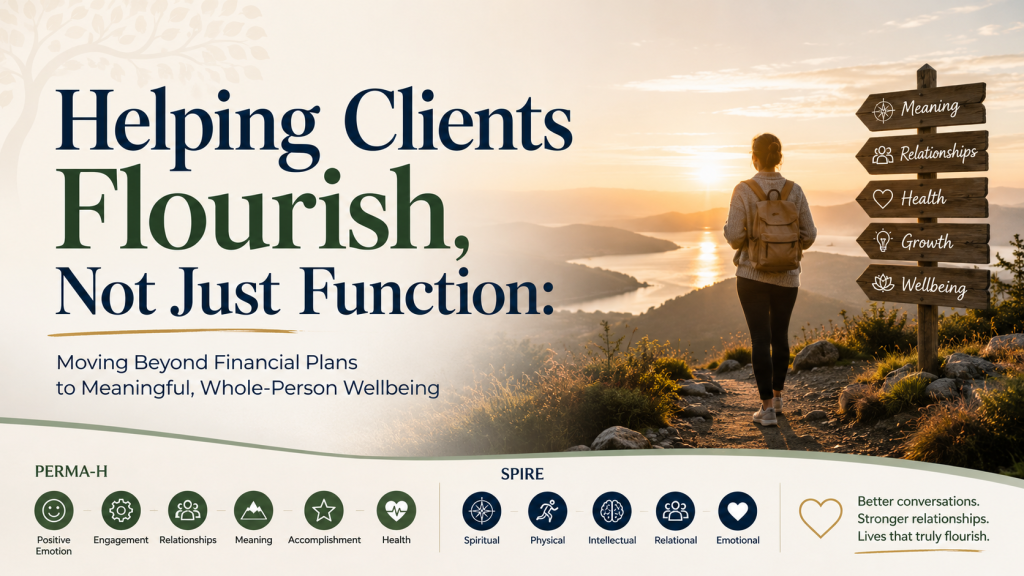
PERMA-H is a wellbeing framework developed by positive psychology pioneer Martin Seligman. It describes six dimensions of human flourishing:
- P — Positive Emotion
- E — Engagement
- R — Relationships
- M — Meaning
- A — Accomplishment
- H — Health
What makes PERMA-H useful for financial coaching is what it lets you see that a cashflow projection cannot show you.
When I look at a client’s financial life through PERMA-H, I start noticing things differently. I see that their savings behaviour is connected to how calm they feel (Positive Emotion). I see that their estate planning avoidance is often connected to a fraying relationship (Relationships). I see that retirement anxiety isn’t really about the numbers; it’s about meaning and identity (Meaning).
Money itself may not create flourishing. But it often creates the conditions in which flourishing becomes possible. Savings influence certainty. Insurance influences peace of mind. Retirement planning influences meaning and identity. Cashflow influences relationships.
PERMA-H gives us a richer map of what clients are actually navigating beneath the surface of every financial conversation.
What Is the SPIRE Model and Why Does It Matter for Financial Coaches?
SPIRE is Tal Ben-Shahar’s model of whole-person wellbeing. It describes flourishing as emerging from five interacting dimensions:
- S — Spiritual wellbeing (meaning and purpose)
- P — Physical wellbeing (health and energy)
- I — Intellectual wellbeing (growth and curiosity)
- R — Relational wellbeing (connection and belonging)
- E — Emotional wellbeing (healthy inner experience)
What SPIRE makes visible is that people don’t experience money in isolation. Financial decisions are embodied.
A debt doesn’t just appear on a balance sheet. It lives in a person’s body as stress, in their relationships as tension, in their sense of identity as shame.
A purposeful financial choice doesn’t just move money. It can strengthen a relationship, restore energy, or deepen a sense of direction.
A salary increase can improve physical wellbeing through reduced stress. Charitable giving can strengthen spiritual fulfilment. Learning about investing can increase intellectual confidence.
SPIRE expands the practitioner’s lens from managing capital to understanding the human system in which money exists. Used alongside PERMA-H, it gives us two complementary frameworks for seeing the whole person, not just the portfolio.
How Does Ontological Coaching Deepen This Approach?
In ontological coaching, we draw a distinction between the world of action and the world of being.
Most financial planning lives almost entirely in the world of action: what to do, how to structure, when to implement. But the world of being is where clients actually live. It’s the mood they bring to a financial conversation, the stories they tell themselves about money, the identity they inhabit as savers, spenders, avoiders, or controllers.
Used ontologically, PERMA-H and SPIRE aren’t just wellbeing models. They become distinctions, ways of seeing that open up new conversations, new observations, and new possibilities for the client.
Mood matters enormously here. A client in anxiety hears risk. A client in resentment hears obligation. A client in peace hears possibility. Recognising the mood a client is in shapes how we enter the conversation, what questions we ask, and what kind of listening we offer.
Language also matters. When a client says “I just want to feel secure,” the ontological coach pauses and asks, “What would security feel like for you?” rather than moving immediately to asset allocation. That pause is where flourishing begins.
What Gets in the Way of Flourishing-Oriented Financial Conversations?
There are four patterns I see most often that block this kind of work.
Technical reductionism is the belief that if the numbers are right, the job is done. It’s seductive because it’s measurable. But it quietly excludes the human being sitting across from us.
Emotional bypassing is moving so quickly from what the client feels to the solution that we never really hear what the financial plan is supposed to be serving.
Flourishing as luxury thinking is the assumption that conversations about meaning and wellbeing are reserved for high-net-worth clients. In my experience, the client with modest resources and a clear sense of what money is for is often far more purposeful than the wealthy client who has never been asked that question.
And model dependency is treating PERMA-H or SPIRE as a checklist to complete rather than a lens through which to see. These frameworks are invitations to observe, not templates to fill in.
What Makes Flourishing-Oriented Conversations Possible?
The most powerful ally is curiosity. Not the kind that performs interest, but the kind that genuinely wants to understand what money means to this particular person at this particular moment in their life.
Reflective listening creates the space for deeper conversation. When a client says, “I just want to feel secure,” curiosity asks what security actually means to them. That question alone can shift the entire planning conversation.
Mood awareness is central to ontological practice. Notice the mood your client is in at the start of a meeting, and let that inform how you enter the conversation. A client in anxiety needs a different opening than a client in excitement.
Longitudinal relationship may be the most important ally of all. Flourishing is not a conversation you can have once. It emerges over time, as trust deepens and the practitioner earns the right to ask bigger questions.
How Can Financial Planners Practically Integrate PERMA-H and SPIRE?
I think of integration in three layers.
Layer 1: Technical Functioning
The foundation. Income, debt, risk, investment, retirement. Still non-negotiable. Still has to be excellent. This layer doesn’t disappear; it deepens.
Layer 2: Human Flourishing (Second Order Conversations)
This is where PERMA-H and SPIRE enter the conversation, not as formal assessments, but as a set of questions that sit alongside the technical work.
Questions that have opened rich conversations in my practice:
- On Positive Emotion: What financial habits give you a sense of calm or confidence?
- On Engagement: What does it feel like when you’re genuinely involved in your financial life, rather than avoiding it?
- On Relationships: Is money drawing you closer to the people who matter, or creating distance?
- On Meaning: What is this financial plan actually in service of?
- On Accomplishment: What progress have you made that you haven’t fully acknowledged?
- On Health: How is your financial life affecting your energy, your sleep, your sense of ease?
Through SPIRE: Which dimension of your life feels most nourished right now? Which feels most neglected? What financial decision would support greater balance?
Layer 3: Transformational Growth (Identity Shifts)
This is where identity shifts happen. Where a client stops being someone who “struggles with money” and starts inhabiting a new self-interpretation. This layer requires time, trust, and a practitioner willing to work with language and meaning, not just behaviour.
What First-Order Habits and Tools Support Financial Flourishing?
For clients and practitioners who want to begin building flourishing into their financial lives, here are four practical starting points:
A monthly “money and meaning” conversation. Set aside 20 minutes each month, with yourself or a partner, to ask not just “how are the finances?” but “how is my financial life serving the life I want to live?”
A flourishing-framed annual review. Alongside tracking financial progress, ask: Is my financial life helping me live the way I want to live? What has this year’s financial decision-making made possible?
A values-aligned spending review. Look at where money is actually going and ask honestly: does this reflect what matters most to me? Misalignment between spending and values is one of the quietest sources of financial dissatisfaction.
A SPIRE check-in at each financial review. Before or after the numbers conversation, ask: Which dimension of my wellbeing is my financial life most supporting right now? Which is most neglected? This single question can redirect an entire planning conversation.
What Should Clients Reflect on Before or After a Financial Planning Meeting?
If you’re heading into a financial conversation, or reflecting on your financial life, these three questions are worth sitting with:
What is my financial plan actually in service of? Not what I’m saving for, but what kind of life I’m trying to make possible.
Where does my financial life feel most alive? And where does it feel like going through motions?
If I’m honest, is money drawing me toward flourishing, or just keeping me functioning?
There are no right answers. But the quality of the question shapes the quality of the life.
How Can Financial Planners Start Applying This in Practice Right Now?
You don’t have to restructure your practice to begin. You can start with one question per client conversation that reaches beyond the technical.
Notice the mood your client is in at the start of a meeting. Let that inform how you enter the conversation.
At the end of a planning session, try asking: Of everything we covered today, what feels most meaningful to you?
Use the SPIRE dimensions as a quiet internal checklist, not to assess your client, but to notice which parts of their human experience the financial conversation is touching and which parts it’s missing entirely.
Over time, those moments compound. The client begins to experience financial planning as something that belongs to their life, not just their balance sheet. And that changes everything about how they engage, how they commit, and how they grow.
What Is the Real Question Behind All the Numbers?
Financial planning has always been important.
But I think we’re at a moment in this profession where we’re being invited into something bigger: not just helping clients get their financial lives right, but helping them use their financial lives to become who they most want to be.
PERMA-H and SPIRE are not replacements for technical excellence. They’re reminders that technical excellence is always in service of a human being. And human beings don’t just want to function. They want to flourish.
Ronel’s podcast reminded me of that. Ben-Shahar articulated it beautifully. Asebedo and Seay gave it a framework for our profession.
Now the question is what we do with it.
When your clients look back on the work you did together, what do you want them to say it made possible in their lives?
That answer is your real north star. Everything else is in service of it.
References
Asebedo, S. D. & Seay, M. C., 2015. Functioning to Flourishing: Applying positive psychology to financial planning. Journal of Financial Planning, 28(11), pp. 50–58.
Ben-Shahar, T., n.d. SPIRE Model of Wellbeing. Happiness Studies Academy. Available at: https://www.happinessstudies.academy
Jooste, R., n.d. Podcast conversation with Tal Ben-Shahar on the SPIRE Model. [Accessed 2025].
Seligman, M. E. P., 2011. Flourish: A visionary new understanding of happiness and wellbeing. New York: Free Press.
Sieler, A., 2003. Coaching to the Human Soul: Ontological coaching and deep change (Vol. 1). 2007 ed. Victoria: Publishing Solutions.


