
Title
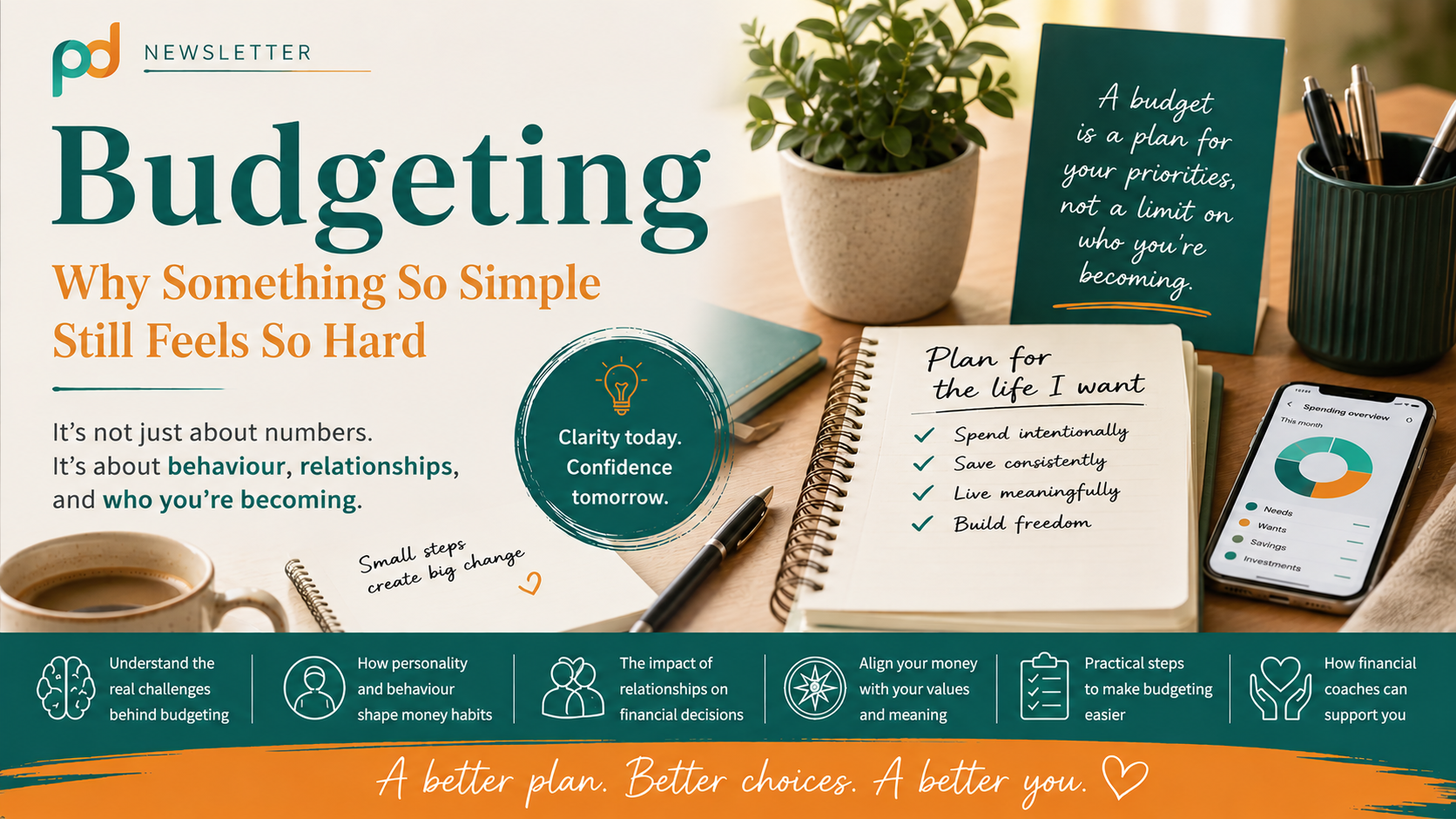
Most people know they should budget. Far fewer manage to stick to one. This piece looks at why, drawing on real South African spending data and the ontological coaching framework, and asks what it would take to approach budgeting differently, starting not with a system, but with curiosity.
Does Budgeting Actually Work?
Yes, and the data from South Africa is surprisingly clear on this.
A University of Cape Town dissertation by Ehsaan Rajak, using real spending data from over a thousand South African consumers on the 22seven platform, found that people who set a budget spent approximately 38% less on average than those who did not. That is a meaningful, measurable shift in financial behaviour, not a marginal one.
But the same data revealed something equally important: people who set budgets still regularly exceeded them. The act of budgeting helped, and yet the planning fallacy, the deeply human tendency to underestimate future costs and overestimate future control, kept showing up.
Budgeting works. And budgeting is hard. Both things are true at the same time.
Why Do So Many People Struggle to Stick to a Budget?
The short answer is that budgeting is not primarily a numbers problem. It is a human one.
Research consistently shows that budgeting difficulty is driven by things far more fundamental than laziness or poor discipline. Present bias pulls people toward immediate relief and away from future benefit. Emotional spending offers temporary comfort when stress is high. Mental accounting, the way we unconsciously separate money into different psychological categories, leads to decisions that make emotional sense in the moment but quietly undermine the bigger picture over time.
Personality matters too. Some people are naturally wired for structure and detailed planning. Others are genuinely built for flexibility and spontaneity. A rigid system designed for a highly conscientious person will frustrate and ultimately fail someone who processes the world differently. There is no single right budget. There is only the budget that fits this particular person in this particular season of their life.
What Is the Planning Fallacy and How Does It Affect Budgeting?
The planning fallacy is the well-documented human tendency to underestimate how much things will cost and overestimate how well future spending will go.
When people sit down to create a budget, they tend to plan for the ideal version of the month ahead, not the realistic one. Unexpected expenses, irregular costs, emotional spending moments, and small daily decisions all get left out of the plan. This is not a character flaw. It is a cognitive pattern that shows up consistently across cultures and income levels.
The practical implication for budgeting is straightforward: a budget that has no room for real life will be exceeded, not because the person failed, but because the plan was never realistic to begin with. Building in buffers, irregular expense categories, and what researchers call spending slack goes a long way toward closing that gap.
Why Does Failing at Budgeting Feel So Personal?
Because for most people, it quietly becomes a story about who they are.
When someone misses a budget target once, it is an event. When it happens repeatedly, it can settle into an identity: “I am just bad with money.” And once that story takes hold, it shapes behaviour as powerfully as any cognitive bias, becoming self-confirming with every small slip.
From an ontological coaching perspective, this is one of the most important dynamics to understand. The mood a person brings to their finances is not background noise. It is the field in which all financial thinking and deciding happens. A person approaching their budget from a mood of shame will make consistently different choices than the same person approaching it from a mood of curiosity. The numbers on the page do not change. The observer does.
What Are the Biggest Psychological Barriers to Budgeting?
Drawing on both the behavioural research and the ontological coaching framework developed by Alan Sieler, several patterns emerge that act as genuine obstacles to financial learning and change.
Cognitive blindness, not knowing what we do not know about our own spending patterns or emotional triggers, is one of the most common. Many people arrive at financial coaching looking for the right app or the perfect system, what Sieler would call being addicted to answers, when what is actually needed is a slower, more honest conversation with themselves. Others carry a mood of resignation, having tried and failed enough times that they have quietly concluded nothing will ever change. And anxiety-driven self-judgment, the constant fear of not being good enough, keeps many people from even opening the conversation about their finances at all.
Recognising these patterns is not a reason to feel worse. It is the beginning of something more useful.
What Actually Helps People Budget More Successfully?
What shifts the dynamic is not a better spreadsheet. It is a different relationship to the learning process itself.
Sieler’s ontological coaching framework identifies several allies of learning that map directly onto what effective financial coaching looks like in practice. Declaring ignorance, being genuinely willing to say “I do not yet understand my own patterns here,” opens a door that self-judgment keeps firmly shut. Curiosity and wonder, approaching one’s spending history as interesting data rather than shameful evidence, changes the emotional tone of the entire exercise. Patience and acceptance, particularly the willingness to stay with discomfort rather than reaching immediately for a quick fix, creates the conditions for real reflection.
And perhaps most importantly: declaring legitimacy as a learner. Recognising that not having this perfectly sorted yet does not make someone a failure. It makes them human, still in the process, and still entirely capable of something different.
What Does Budgeting Have to Do With Values and Identity?
More than most people realise.
At its best, a budget is not a restriction. It is a form of self-leadership. It is a practical answer to a deeper question: what do I want my life to look like, and how am I choosing to use my resources to get there?
The Purpose Driven Financial Coaching approach invites clients to move through three connected questions when sitting with their financial picture. First, what is actually going on here, not just in the numbers but in the mood, the avoidance, the patterns that keep repeating? Second, what does the research and the framework help us understand about why this is genuinely difficult? And third, given all of that, what choices become available that were not visible before?
Budgeting, approached this way, becomes less about controlling every rand and more about ensuring that the way money moves in your life is actually pointing in the direction you most want to go.
Where Should Someone Start if Budgeting Has Always Felt Impossible?
Not with a new app. Not with a stricter system. Start with a more honest and compassionate conversation, beginning with yourself.
Ask what budgeting has meant in the past. Ask what feelings come up when you open your banking app. Ask what story you have been telling yourself about money and whether that story is actually true. These are not soft questions. They are the questions that precede any lasting change.
From there, a simple, realistic structure that fits your personality and your actual life is far more powerful than a perfect system you will abandon in three weeks. The research confirms it. The coaching work confirms it. And most people who have genuinely shifted their financial behaviour will tell you the same thing: something had to shift inside before anything changed on the outside.
Conclusion: Budgeting Is a Human Problem, Not Just a Financial One
The reason budgeting feels hard is not that you are bad at money. It is that budgeting asks something genuinely difficult of us, to override deeply human tendencies, to sit with discomfort, to plan for a future self whose interests compete with today’s impulses, and to keep showing up even when the plan falls apart.
The good news, backed by real South African data and decades of behavioural research, is that the act of engaging with a budget, even imperfectly, even when exceeded, still produces meaningfully better financial outcomes. The container matters. And so does the mood you bring to it.
References
Rajak, E. (2024). Personal Finance: A Statistical Analysis of the Habits and Behaviours of the South African Consumer. Advanced Analytics Minor Dissertation, University of Cape Town.
Sieler, A. (2007). Coaching for the Human Soul: Ontological Coaching and Deep Change, Volume 1. 3rd ed. Victoria: Publishing Solutions.
Hashmitha, S.J. & Deepak, V. (2026). An Analysis of the Effectiveness of Budgeting in Personal Financial Management. International Journal of Versatile Research and Analysis, 4(2).



