
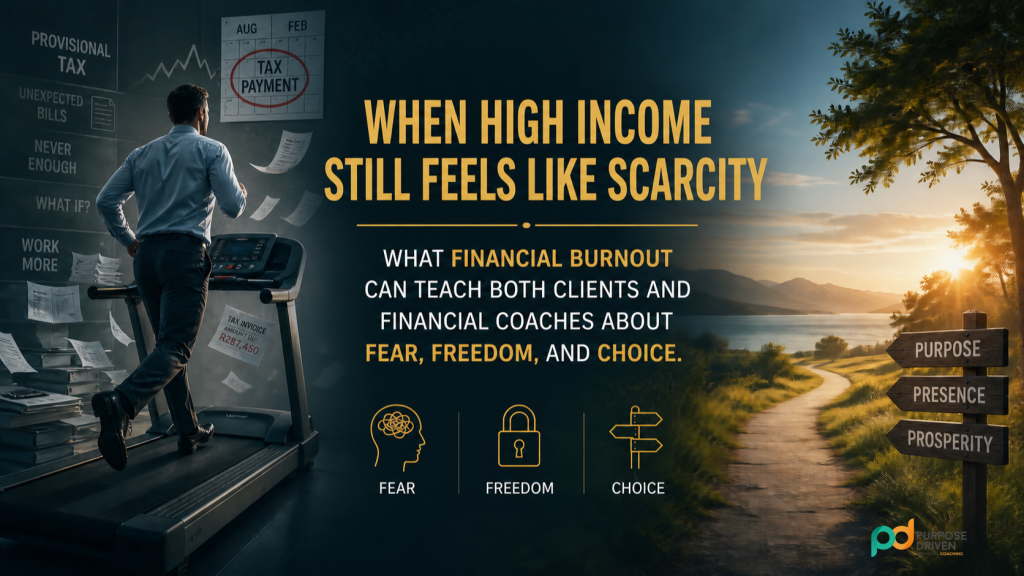
The Provisional-Tax Treadmill: When High Income Still Feels Like Scarcity
What Financial Burnout Can Teach High-Earning Professionals About Fear, Freedom, and Choice
Reading time: approximately 12 minutes
There is a quiet paradox unfolding in many financially successful professional lives. The practice is growing. The income is strong. The client base is healthy. And yet, beneath the spreadsheets and the surface of professional success, many high-earning professionals are carrying a private exhaustion that rarely gets spoken aloud.
“Why do I earn this well and still feel financially trapped?”
This article explores that question honestly, drawing on research in neuroscience, behavioural economics, and coaching psychology to name what is happening, explain why it persists, and open the door to a different way of relating to money.
What Is Financial Burnout in High-Earning Professionals?
Financial burnout, as used in this article, is not a clinical diagnosis. It is a practical description drawn from two well-established frameworks placed alongside each other.
The World Health Organization’s ICD-11 defines occupational burnout as a syndrome of chronic workplace stress that has not been successfully managed, characterised by exhaustion, growing cynicism toward one’s work, and a reduced sense of professional efficacy. The Consumer Financial Protection Bureau defines financial wellbeing not as income or net worth, but as the degree to which a person has security and freedom of choice, both in the present and in the future.
Financial burnout, for this population, sits at the intersection of those two definitions: the chronic erosion of felt security and freedom of choice, accompanied by exhaustion and avoidance, in someone whose income is objectively strong.
It is worth being clear: there is no peer-reviewed body of research that formally measures “financial burnout” as a distinct condition. What the research does give us, solidly, is consistent evidence that self-employed professionals carry greater psychological risk than salaried employees, particularly when income is effort-dependent and unpredictable. Eurofound’s research across the EU documents this pattern clearly. Adjacent professions such as psychotherapy and specialist consulting report burnout rates approaching 45 percent. These findings are close enough to our population to make the pattern credible and worth naming.
Who Experiences Financial Burnout?
The pattern appears most commonly in professionals who earn their income through direct personal output: attorneys, therapists, coaches, consultants, specialist medical practitioners, and similar practitioners in private practice. The profile is usually consistent.
Income is strong. Debt is relatively low. Personal expenses are modest relative to what the practice generates. On paper, things look good. In lived experience, something quite different is happening.
The story that tends to emerge, when you listen carefully, is a version of the same one. At some point, usually at a South African provisional tax payment in August or February, a shortfall appeared. Not because of recklessness, but because somewhere between what the client earned and what was provisioned for tax, there was a gap. A significant one. The kind that required finding R200,000 or R300,000 at short notice, from reserves that were never quite structured for that purpose.
The money was found. The payment was made. And a fear remained that did not leave when the crisis did. That fear, and its persistence, is the heart of this conversation.
Why Does Financial Fear Persist After the Crisis Is Resolved?
This is where neuroscience offers something genuinely useful.
Lisa Feldman Barrett, in her book How Emotions Are Made (2017), challenges the assumption that the brain simply reacts to events as they occur. Her research proposes that the brain is fundamentally a prediction machine. Rather than waiting for experience to arrive and then responding, it constantly generates predictions about what is likely to happen next, based on prior experience, and uses those predictions to prepare the body in advance.
When a professional lives through a significant, unexpected financial shortfall, the brain logs it as a category of threat: large, unexpected demand, insufficient reserves, stress response required. From that point forward, the brain anticipates that pattern recurring. Not because the person is anxious by nature, but because the brain is doing exactly what Barrett describes: constructing an emotional experience from prior data and projecting it forward as prediction.
The fear that remains after the crisis is resolved is therefore not irrational. It is the predictive brain running a simulation it has run before. A medical bill, a car breakdown, a cancelled client run, these become part of the same predictive category: the unexpected large demand that I may not be ready for. The original trigger was tax. The anticipatory pattern, once established, is broader.
Barrett also introduces the concept of the body budget, the brain’s continuous management of the body’s metabolic resources. Uncertainty is a withdrawal from that budget. Chronic anticipation of an unpredictable demand keeps the budget in a state of quiet deficit, experienced as persistent fatigue, shortened planning horizons, and a reduced capacity for exactly the kind of forward thinking that would resolve the underlying problem. The professional on the treadmill is tired not only from working hard, but from the continuous background cost of monitoring for the next surprise.
How Does Scarcity Affect Financial Decision-Making?
Research by Mullainathan and Shafir, published in their 2013 book Scarcity: Why Having Too Little Means So Much and supported by a landmark study in Science (Mani et al., 2013), shows that scarcity, whether real or perceived, consumes cognitive bandwidth. When a person’s mind is preoccupied with a looming financial demand, their available attention narrows. Long-term planning becomes more difficult. The ability to hold competing priorities simultaneously is genuinely reduced.
This is crucial: scarcity is not only about low income. It is about perceived insufficiency relative to obligation. A high-income professional who is carrying the anticipation of the next unexpected financial demand may still experience the cognitive and emotional effects of scarcity psychology, regardless of what the bank balance actually shows.
In practice, this can produce tunnel vision focused on the immediate threat, short-term thinking that crowds out longer-horizon planning, avoidance of financial information and conversations, delayed retirement planning and investment decisions, and a general narrowing of perceived options.
This is why highly capable professionals can expertly manage complex client matters on Tuesday afternoon and still find themselves unable to think clearly about their own financial plan on Wednesday morning. The capability is present. The available bandwidth is not.
What Is the Difference Between Financial Planning and Financial Coaching?
Understanding this distinction matters for deciding what kind of support is most useful.
Traditional financial planning focuses primarily on the technical dimensions of a financial life: tax structuring, investment selection, insurance coverage, retirement provision, and estate planning. It is essential work, and it answers the question “what should I do with my money?”
Financial coaching works on a different level. It explores the behavioural, psychological, and relational dimensions of financial life: the patterns of fear and avoidance, the identity concerns that drive overwork, the inherited beliefs about money that operate below conscious awareness, the habits that persist despite good intentions, and the question of what the money is ultimately for. It addresses a different question: “Why do I keep doing what I do, even when I know what I should do differently?”
For many high-income professionals, both matter. A well-designed financial plan implemented by someone in a chronic state of financial fear will not produce the security and freedom that the plan, technically, makes available. And a coaching conversation without a sound underlying structure leaves the client with insight but no architecture to support it. The most durable results tend to emerge when both dimensions are addressed together.
What Is Mood and Language in Financial Life, and Why Does It Matter?
Ontological coaching, drawing on the foundational work of Rafael Echeverría and the Newfield Network tradition, pays close attention to the role of mood in shaping what a person can perceive as possible. In this framework, mood is not simply a feeling to be managed. It is a pre-reflective orientation, a background atmosphere that colours everything a person perceives and therefore shapes what actions seem available to them.
The mood that tends to emerge from the pattern described in this article is one of vigilance. The professional is still functioning, still producing, still meeting every obligation. But beneath the activity there is a quiet orientation toward threat, a background scanning for what might go wrong, a difficulty being fully present in the good months because the next potential surprise is always somewhere in the periphery.
The language of this mood is worth listening for, because it reveals the underlying concern more honestly than any direct question usually does.
“I cannot afford to slow down.” “What if something goes wrong?” “I had better not.” “Let us wait until things are more settled.”
These are not descriptions of financial reality. They are expressions of a mood that is generating a particular world, one in which the next surprise is always probable and the available response is always to work more and spend less. What this mood makes invisible is precisely the space that exists for genuine choice.
How Can Ontological Coaching Help Financial Burnout?
Ontological coaching offers a specific and practically useful intervention at this level, not by prescribing a different set of financial decisions, but by making visible the concern that is organising the current ones.
The central question that ontological coaching asks in this context is: what concern is driving your financial behaviour? Not what are your goals or what is your strategy, but what underlying concern, operating in the background, is determining what you can see as possible and what you cannot?
For many professionals in this pattern, the answer to that question reveals something more personal and more specific than “I want to manage my cash flow better.” It might be financial shame: the deep dread of being seen to have not managed things properly. It might be a memory that precedes the practice altogether, a household that always felt financially precarious. It might be an identity question: if the income drops, or if I genuinely slow down, who am I then?
These are not questions for a financial plan to answer. They are questions for a reflective conversation, one that invites the client to examine the concern organising their financial life and to choose, consciously, whether that concern is still the one they want at the centre of it.
This shift, from fear-driven earning to conscious stewardship, is the practical outcome of the ontological work. It does not replace sound financial structure. It makes that structure liveable.
What Practical Steps Can Reduce Financial Burnout?
The research points to a response that works on two levels. Both matter, and they are most effective when addressed together.
1. Create a dedicated tax reserve account. Treat provisional tax the way PAYE treats income tax for a salaried employee: deduct it first, before the money enters the general flow of the business. When revenue arrives, a defined percentage moves immediately to a ring-fenced account held at a separate institution. The practitioner never sees that money as available income, because it was separated before it had the chance to feel like it. When the August or February payment arrives, it draws from a purpose-built reserve rather than from savings or emergency funds. The surprise, structurally, becomes impossible.
2. Build a five-account or envelope system. The broader architecture separates money by function from the moment it arrives. A revenue-clearing account receives all client payments. A tax reserve account holds the provisional tax percentage. An operating account funds business expenses. A personal income account pays a fixed monthly amount to the practitioner regardless of how the month performed. A freedom or discretionary account holds a small, ring-fenced allocation for deliberate enjoyment. This is not complicated bookkeeping; it is deliberate mental accounting in service of freedom.
3. Build a personal contingency reserve. A separate, modest buffer for unexpected personal expenses, medical, vehicle, household, changes the character of those events from unpredictable threats to funded possibilities. The reserve does not need to be large to do its neurological work. It needs to be present, clearly designated, and never pooled with operating funds.
4. Optimise the available tax structures. South African professionals at the top of the income scale have access to significant legitimate levers that are often underused. Section 11F retirement annuity contributions are deductible up to 27.5 percent of taxable income, capped at R350,000 per year. The tax-free savings account allows R36,000 per year, rising to R46,000 from 1 March 2026, within a R500,000 lifetime limit. Practitioners considering incorporation should be aware of the Personal Service Provider rules, which can make a Pty Ltd structure significantly more expensive rather than less. Tax sequencing, the order in which levers are deployed, matters as much as the levers themselves.
5. Define “enough” as a real number. Without a personal definition of enough, more can become a permanently moving horizon. The question “what would financial freedom actually look like in my specific life?” is one of the most practically useful conversations a financial coach can facilitate. The answer is always personal, and it is almost never simply a higher income.
6. Engage in future-self reflection. The research on future-self continuity consistently shows that making the future self vivid and concrete increases the willingness to make decisions in its service today. The question “what is this money ultimately for?” sounds deceptively simple. In practice, it tends to surface values, priorities, and regrets that reorganise everything downstream.
What Questions Should You Ask Yourself About Financial Fear?
The following questions are offered not as a diagnostic checklist but as an invitation to reflection. They work best when approached slowly, with genuine curiosity rather than a rush toward an answer.
- What specific financial event am I most afraid of?
- When did this fear become significant in my life?
- Is this fear based on my present financial reality, or is it the predictive brain replaying a past experience?
- What concern is driving the intensity with which I currently work?
- What would it actually feel like to have enough?
- What would financial freedom look like in my specific, daily life, not as an abstract concept but as a lived experience?
There is no prescribed answer to any of these questions. The value, as always in this kind of reflection, is in the quality of the asking and the willingness to sit with what comes up.
When Should You Consider Working With a Financial Coach?
Financial coaching may be particularly useful if you recognise yourself in any of the following.
You earn well but still experience a persistent sense of financial tightness or constraint. Tax obligations create anxiety that feels disproportionate to your actual financial position. You find yourself working harder than you genuinely want to, driven more by financial fear than by professional passion. You struggle to slow down even when the numbers suggest it would be safe to do so. You feel financial unease even in months when cash flow is strong. You want your financial life to align more consciously with the things that actually matter to you.
These are not signs of financial incompetence. They are signs that the structure, the psychology, or the meaning dimension of your financial life, or some combination of all three, is asking for attention.
Can You Experience Financial Burnout Even If You Earn Well?
Yes, and the research is clear on this.
High income does not automatically produce peace, freedom, confidence, or felt security. The Consumer Financial Protection Bureau’s definition of financial wellbeing is deliberately built around the experience of security and freedom of choice, not around income or net worth, precisely because those things can be present at a high income level and still be absent from the lived experience.
Without the right structure, the provisional tax system will continue to create concentrated moments of financial shock that train the predictive brain to anticipate the next one. Without the right psychological framework, that anticipation will narrow cognitive bandwidth and sustain a mood of vigilance regardless of what the numbers show. Without the right meaning, even a well-optimised financial structure will feel like a more efficient treadmill rather than a pathway to genuine freedom.
Structure, psychology, and meaning work together. Addressing only one of them tends to leave the others in place.
Financial Freedom Is Not Just a Bigger Income
For many South African professionals in private practice, the path forward is not primarily about earning more. It is about building an architecture that converts unpredictable obligations into funded certainties, understanding the deeper concerns that have been quietly organising financial behaviour, and creating the conditions for more conscious, values-aligned choice.
Sometimes the greatest financial breakthrough is not a higher number. It is a different relationship with the number you already have.
Final Reflection
If your financial life looks successful from the outside but feels tighter on the inside, your exhaustion is not evidence of failure. It may be the most useful signal your financial life has sent you, pointing toward something in the structure, something in the nervous system’s learned anticipation, or something in the beliefs and concerns organising your relationship with money, that is ready for a different kind of attention.
The real opportunity, for many high-earning professionals, is not financial growth alone. It is financial freedom: the experience of security and genuine choice that strong income was always meant to make possible.
References
Barrett, L.F., 2017. How emotions are made: The secret life of the brain. New York: Houghton Mifflin Harcourt.
Barrett, L.F., 2020. Seven and a half lessons about the brain. New York: Houghton Mifflin Harcourt.
Consumer Financial Protection Bureau, 2015. Financial well-being: The goal of financial education. Washington, DC: Consumer Financial Protection Bureau.
Eurofound, 2017. Self-employment in the EU: Job quality and developments in social protection. Luxembourg: Publications Office of the European Union.
Mani, A., Mullainathan, S., Shafir, E. and Zhao, J., 2013. Poverty impedes cognitive function. Science, 341(6149), pp.976–980.
Mullainathan, S. and Shafir, E., 2013. Scarcity: Why having too little means so much. New York: Times Books/Henry Holt.
Shefrin, H.M. and Thaler, R.H., 1988. The behavioral life-cycle hypothesis. Journal of Economic Perspectives, 2(3), pp.609–643.
Parikh, J. et al., 2022. Prevalence of burnout in private practice radiology leaders. Clinical Imaging, Vol 92. December 2022, Pages 1-6.
Thaler, R.H., 1999. Mental accounting matters. Journal of Behavioral Decision Making, 12(3), pp.183–206.
World Health Organization, 2019. Burn-out an occupational phenomenon: International Classification of Diseases (ICD-11). Geneva: World Health Organization.


